
An LLM wiki: project memory for Claude Code that survives compaction
How I stop Claude Code from forgetting: a foldered markdown wiki, a routing table, a lessons file and three hooks that reload them after compaction.
An LLM wiki is a folder of small markdown pages in your repo that the agent reads instead of asking you again. Mine lives in .claude/project-info/. CLAUDE.md routes each task to the right pages, hooks bring those pages and the lessons back after every compaction, and a Stop hook won't let a code change finish without a wiki update.
TL;DR
- The problem: every session starts empty, compaction drops details, and a CLAUDE.md big enough to hold everything costs context on every request.
- The setup: small pages, a short CLAUDE.md that routes words to pages, and three hooks: route each prompt, reload the lessons after compaction, block a finish when code changed but the wiki didn't.
- The habit: every correction becomes a dated one-line rule in
lessons.md, and a rule that keeps coming back becomes a test, a lint rule or a hook.
Why a wiki and not a bigger CLAUDE.md?
The memory docs start with the problem: "Each Claude Code session begins with a fresh context window." Long sessions add a second one. Compaction summarizes the conversation to free space, and the hooks guide warns it "can lose important details". Chat-only instructions go first: if one disappeared after compaction, the docs say, "it was given only in conversation".
The obvious fix is CLAUDE.md, which the context window docs list among what survives compaction. But it loads in full on every request, and the docs suggest staying under 200 lines because "longer files consume more context and reduce adherence". Imports don't help: imported files also load at launch.
A portfolio with a brand voice, a design system, three locales, legal pages and a CV has far more than 200 lines of facts. So the facts go into a wiki, and CLAUDE.md becomes its index.
Where does the idea come from?
Andrej Karpathy published the pattern in April 2026 as an "idea file" called llm-wiki (opens in a new tab): the LLM "incrementally builds and maintains a persistent wiki" of markdown files between you and your raw sources. It has three layers (raw sources, the wiki, a schema document such as CLAUDE.md), three operations (ingest, query, lint), an index.md catalogue and an append-only log.md.
Mine applies the same idea to one software project instead of a research topic. Three things differ:
- The raw sources are me, the repo and dated research notes.
- The wiki steers an agent that writes code, so it holds rules (a working agreement, lessons), not only knowledge.
- Hooks deliver the right pages. I don't rely on the agent remembering to read the index.
My log even keeps the gist's ## [date] area | summary shape, which stays greppable.
How is it laid out?
.claude/project-info/
├─ README.md · working-agreement.md · lessons.md
├─ open-questions.md · placeholders.md · log.md
├─ product/   why and what: brief, requirements, audience, voice
├─ content/   what the site says: content model, projects
├─ site/      structure, SEO, i18n, analytics
├─ design/    design system, references, quality rubric, assets
├─ tech/      stack, conventions, one how-to page per library
├─ legal/     facts behind the legal pages
├─ memory/    measured numbers
└─ research/  raw dated notes (not routed)
Just over 30 pages live outside research/, grouped by the question they answer: why, what, how it's organised, how it looks, how it's built. The root files stay at the root because the hooks look for them there.
Which rules keep it honest?
- One owner per fact. Each fact lives in one page and the others link to it. Copies drift apart.
- Facts carry their source.
[user]for my decisions,[research]for findings,[repo: path]for what the code says,[assumption]for a guess. A guess gets revisited, a decision doesn't, and a grep for[assumption]lists what is still unconfirmed. - Unknown beats invented. A missing fact is written as Unknown and goes to
open-questions.md: the question, what it blocks, who answers, the default if nobody does, and the status. - Not-real things are registered. Every placeholder gets a row in
placeholders.md, and "go to production" means clearing that list first. - Dense, not long. Tables and short bullets, roughly 40-150 lines a page. A page you can skim in a minute gets read.
- The code wins. When a page and the code disagree, the page gets fixed.
How does the machinery work?
- 01 Route A hook matches the prompt's words to the routing table and names the pages.
- 02 Read Claude opens those pages, next to the lessons the session card loaded.
- 03 Work It builds and runs the checks with the facts in front of it.
- 04 Log + lesson The page that changed is updated, log.md gets a line, a correction becomes a rule.
CLAUDE.md as a router
My CLAUDE.md is 76 lines: the routing table, the invariants and the commands. Each row pairs the words people actually type with the pages to read:
| Task touches | Read |
| --- | --- |
| Locales, translation, Lingui, Polish, Spanish, language switcher, hreflang, URL prefix, slugs | `.claude/project-info/site/i18n.md` |
| Code style, folders, git, commits, testing bar, do-not list | `.claude/project-info/tech/conventions.md` |
Routing per prompt
A UserPromptSubmit hook runs before Claude sees each prompt, and its output joins Claude's context. Mine scores the prompt's words against each row: an exact match counts 1, a plural 0.9, a shared prefix of five or more letters 0.6. Each score is divided by the square root of how many rows hold that word, so words that appear everywhere count for little.
At most five rows get through. A small JSON file maps Polish word stems to table words, so Polish prompts route too. The hook's test mode:
> przetłumacz stopkę na hiszpański
  1.00  Pages, sitemap, home sections, hero, header, navigation, footer...  [footer]
  1.00  Locales, translation, Lingui, Polish, Spanish, language switcher...  [spanish]
> where did I leave that
  (nothing routed)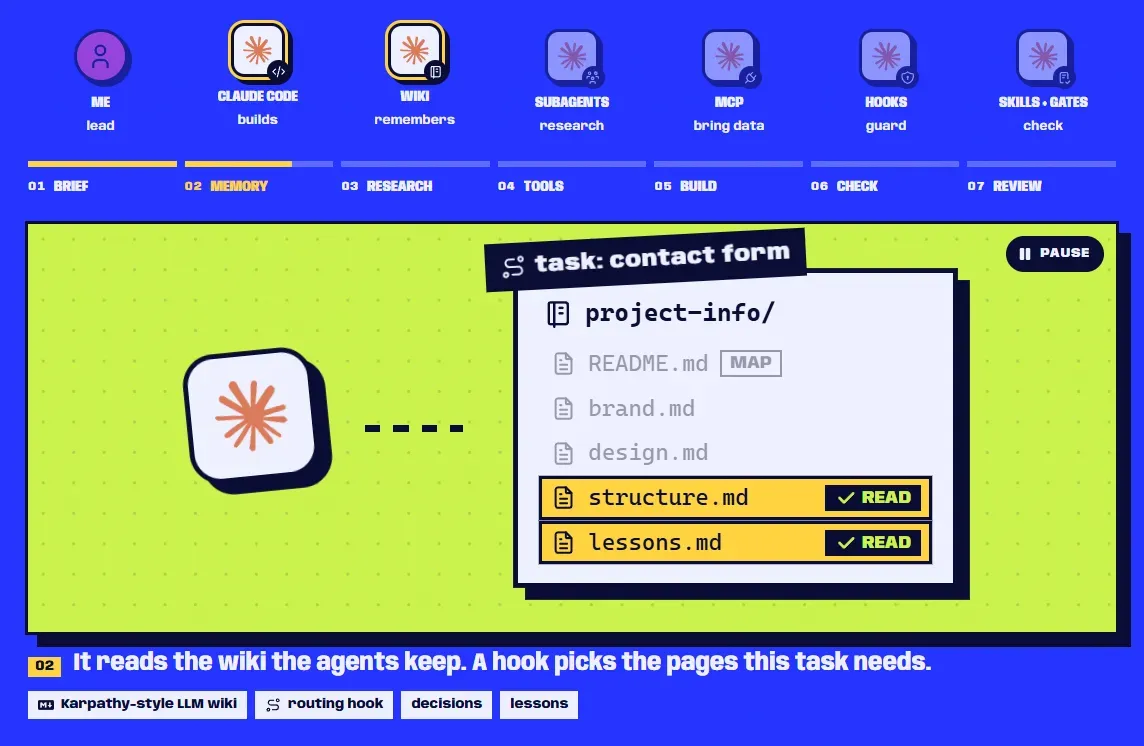
The session card
SessionStart fires on startup, on resume, after /clear and after compaction, and tells the hook which. The hooks guide recommends exactly this, with a compact matcher, "to re-inject critical context after every compaction". Mine prints:
- a note for the occasion (after compaction: "This is not a pause: carry on with the current task");
- a pointer to the working agreement;
- the git state, as counts only;
- the
## Rulessection oflessons.md, capped at 8,000 characters.
The Stop check
When Claude finishes a turn, a Stop hook compares what changed in the session (commits since it started, plus the working tree) with what changed in the wiki. Code changed and the wiki didn't? It blocks the stop once and lists the steps: update the page, append to log.md, record a lesson, or say that nothing documented changed. If the wiki changed, it runs the lint and blocks on errors.
The docs give two loop guards: the stop_hook_active input and a cap on consecutive continuations. My script adds a third: it remembers the state it last blocked on, so the same diff never blocks twice.
How does the lessons loop work?
If I had to drop everything else, I'd keep lessons.md. When I correct Claude, or a tool trips it, the fix becomes one dated, imperative line under ## Rules:
- Git Bash rewrites URL-path arguments (`/en/` → `P:/Git/en/`): prefix with
  `MSYS_NO_PATHCONV=1`, also for `bun run lhci` - 2026-10-05.
The session card injects that section, so every session and every compaction starts with all the rules. Product facts go to their own page instead, measured numbers to memory/. The file aims to stay under 60 rules and the card's 8,000 characters, and a rule that keeps coming back becomes a check (a test, a lint rule, a hook), because enforced beats remembered.
Claude Code's built-in auto memory is different: notes Claude writes for itself, with a MEMORY.md index whose first 200 lines or 25 KB load at every session start, on one machine only. The lessons file lives in git, so I review its changes in diffs like code.
How do you start one?
- Run
/initor write a short CLAUDE.md by hand: commands and non-negotiables. - Create
.claude/project-info/with five root files:README.md(the map),working-agreement.md,lessons.md,open-questions.md,log.md. - Add pages only when the project needs them. A CLI doesn't need a brand page.
- Write the routing table in the words you actually type, synonyms included.
- Add hooks one at a time: SessionStart first (lessons after compaction), then routing, then the Stop check.
- Test routing with five realistic prompts and one noise prompt that should route nowhere.
- End every task the same way: verify, update the page, append to the log, add a lesson if you were corrected.
I packaged steps 2-6 as a skill, so a new project starts with the same machinery. When I set up this repo, the routing test used 15 prompts, including 4 in Polish and one noise prompt.
Limits
- Drift is real. The wiki is only as true as its last update. One read-through as a stranger, when the wiki had 26 pages, found about 40 contradictions between pages. The Stop hook proves that something in the wiki changed, not that it's right.
- Routing misses. It scores keywords, not meaning, so a generic phrase can outscore the page that matters. Shared task words go in every row they apply to, and the test runs again.
- It costs tokens and time. The card puts up to 8,000 characters of rules into every session, and every task ends with documentation work. I haven't measured the net saving; I only know I stopped repeating myself after compactions.
- It's advice, not enforcement. Like CLAUDE.md, the wiki is context, not configuration. Anything that must hold every time belongs in a hook or a test.
- It can leak. A wiki in git is a wiki someone might read. Name environment variables, never their values. My lint scans the wiki for key-shaped strings.
How the wiki fits next to skills, MCP servers and subagents is in Claude Code skills, hooks, MCP servers and subagents, and the whole build is in the case study. The wiki step plays live in the AI section on the home page. If you want this kind of process on your team, get in touch.
Sources
- How Claude remembers your project (Claude Code docs) (opens in a new tab) (accessed )
- Automate actions with hooks (Claude Code docs) (opens in a new tab) (accessed )
- Hooks reference (Claude Code docs) (opens in a new tab) (accessed )
- Explore the context window (Claude Code docs) (opens in a new tab) (accessed )
- llm-wiki, an idea file by Andrej Karpathy (GitHub Gist) (opens in a new tab) (accessed )